SearchAre you ready?
Account toolsUser loginWho's onlineThere are currently 0 users and 15 guests online.
|
Dirk Mueller: The Genesis of a Plasma patchAt one day, there was a patch. The patch was small and in early development, and it was posted to the Plasma review board. A couple of minutes later, the patch was rejected. Many reasons were given: The patch didn't have the right intention, it would cause bitrod, and it broke the coding style. Not a big thing, this happens every day in a Free Software Environment. Neither something to get excited about nor something to loose hair over it. Thats the end of the story? Not quite, in the bible it took 7 days as well, right?. So lets look at it a bit more closely. Day one: The review said that the patch contained a coding style error. Of course the review didn't mention where the coding style error was, or even better, on how to fix that (didn't the review board have this awesome patch annotation feature?). It is a quite obvious way to motivate a possible new contributor by giving him constructive feedback on how to improve his patch. Not a big deal? Not a big deal. However, as it was mentioned as the last point in a long rambling did make it smell a little bit like "Even if you manage to fix all the flaws mentioned before, have fun figuring out how you make me like the arrangement of spaces in your patch!". There was Day, and there was night. 2nd. Day. Now.. where was I? Ah right, light!.. eh Plasma! So, the patch had its intention to hide the Plasma toolbox from the KDE 4.0.x desktop. The KDE 4.0 desktop was released in January in its first stable release, intended for early adopters. It was expressed quite clear that it is not finished yet ,and the adequate set of features will come with KDE 4.1. So what would be more obvious to highlight the pure beauty and new shininess of KDE 4.1 by introducing a feature-complete plasma toolbox with KDE 4.1? I spend my second day thinking about this. There was Night, and there was Day. 3rd Day. Lets enjoy some quote from the review: you can, of course, put this patch in your downstream builds. you'll be doing the project a disservice, however. or are we not actually developing software in the open anymore but only delivering a final product and therefore completely avoiding the entire feedback cycle? A couple of things to notice: The patch wasn't posted by a distribution, it was posted by a KDE developer. It does sound strange that a normal KDE developer is suddenly downstream and only Plasma developers are upstream, but this is how it was communicated. Ah, you're saying that I'm ironic and that I know that in my other live I'm also a distro guy? Fair enough, I should have known that. Obviously I cannot be two persons at the same time. And of course I'm doing a disservice to the project by posting a patch to upstream (!) instead of just patching it downstream. In addition my disservice to the project is trying to polish a stable code branch (nowhere this patch was mentioned to be intended for the KDE 4.1 development tree). I'll spend the rest of the day thinking about if we want to alienate our userbase even more by making them swallow down an unfinished product with rough edges and give them the feeling that whatever code branch, name it stable and released or unreleased and in development, they get the same amount of bleeding. Be free, and bleed freely. There was Night, and there was Day, 4th Day. So, it turns out, I wasn't the first person to notice that the toolbox has only two features:
While it is arguably true, that the "Add plasmoid" (it is actually called "Add widgets" btw) has some value (the same value the context menu on the background, the panel, the kickoff menu and probably a couple of other places have as well). Note that I also don't want to mention how KDE 3 users have managed to find the hidden context menu in the past to add an applet to their panel, not because it is unimportant, just that I only have one week and I'm already at day 4. So day four: I've asked my girlfriend what she thinks a widget is. And even though she lives with me for several years already, she couldn't describe it properly, nor explain me what she would expect to happen when she presses the button. Obviously its a translation thing, right? A "Widget" is the same as "I don't know the name of this thing" in German. Ah, so it adds a little "I don't know what its name is?" to "I don't know where" ? That makes perfect sense for this feature! I spent the rest of the day being depressed that I didn't take a picture of her face. I would have seen value in adding that picture to my desktop background.So there was Night, and there was Day. 5th Day. You're expecting me to follow up on the "Break your desktop" ? Okay, well.. its the general reaction you get when you let new people that pop up on a fair where you demo the desktop try it. They go like "uhh.. it turns white.. I broke it!" and jump away from the computer, being frightened that they made a change that they cannot undo. but there is undo, right? Well, only 3 levels of undo, to be honest: if you zoom out more than 3 times, you cannot zoom back in, because you can't actually press the button anymore. The only way to undo that is to delete your plasma configuration or, for the average user, to reinstall your computer. Oh, another thing you learn from being a distro guy: whenever something happens that average users don't expect and they can't undo: they either call support (be it the 24 hour child/mother support hotline or some other) or if they have a little bit more knowledge, reinstall their computer. Or they ask somewhere on the net and get the recommendation to rm -rf ~/.kde. I spent the rest of the day enjoying the other blog about the "break your desktop" button and the followup, which was particularly funny. Unfortunately I cannot link that one anymore because the blog posting was pulled from the net. you can still find it in the Google cache if you try really hard. In essence it said that whenever one has a certain issue with Plasma, one should contact the developer mailing list instead of publically blogging about it. Which I did, btw. Or didn't I? Did I only blog because somebody else blogged about my blog which I'm writing now? Damn, I wish I'd had a day left to think about that. So there was Night, and there was Day. 6th Day. I think after collecting the pieces, it is time to finish up. Or in my case, understand the big picture. Perhaps today "it also will grow into something that has clearer purpose". But wait, isn't that admitting that the previous days didn't have a clear purpose? The big picture for me is that somewhen we've apparently forgotten what it takes to be a good community: Be friendly, be constructive, allow different opinions to co-exist and clearly distinguish between technical issues and emotionally-overloaded sandbox-thinking. An additional bonus is to provide leadership by actually inspiring others and give them a clear vision, a vision that they can implement, that they can bugfix and polish and that they can understand well enough to share it with others. So there was Night, and there was Day. 7th Day. And today, I need a bit of rest from all the blogging. Doesn't it piss you off as well that you can ping as much as you like, be open and constructive for a discussion as you like and still only end up being able to write up your own thoughts up in a post without actually being able to establish any constructive mind-sharing? So, thats it. Or as downstream puts it: Have a lot of fun. Categories: KDE blogs
Roland Wolters (liquidat): Howto: Test the WebKit engine in Fedora
However, at the moment most of these developments are not here yet. But Fedora’s WebKit packages come along with basic WebKit browsers which can be used to test some websites against WebKit: # rpm -qa|grep -i webkit WebKit-doc-1.0.0-0.3.svn28482.fc8 WebKit-gtk-devel-1.0.0-0.3.svn28482.fc8 WebKit-qt-devel-1.0.0-0.3.svn28482.fc8 WebKit-qt-1.0.0-0.3.svn28482.fc8 rpm WebKit-gtk-1.0.0-0.3.svn28482.fc8 # rpm -ql WebKit-qt /usr/lib/libQtWebKit.so.1 /usr/lib/libQtWebKit.so.1.0 /usr/lib/libQtWebKit.so.1.0.0 /usr/libexec/WebKit /usr/libexec/WebKit/QtLauncher # ls /usr/libexec/WebKit/ DumpRenderTree GtkLauncher QtLauncherThe two executables QtLauncher and GtkLauncher are a simple browser based on Qt or Gtk, respectively. Since the path is usually not part of PATH the browsers must be started from the command line with the full path, /usr/libexec/WebKit/QtLauncher for example. After you’ve called that line via ALT+F2 the browser comes up. But don’t expect too much: these are just basic browsers to show off the capabilities of the WebKit engine - nothing more. They are definitely not ready for production use - or any real use at all. The Qt version does not know how to handle addresses without the http://, usual shortcuts like Ctrl+L are not working, and plugins are not embedded at all. However, the Qt launcher has a nice effect of showing a link address when you hover over a link. The Gtk launcher is in a bit better shape: it does at least understand addresses, but than again it does not fill in the http:// after loading the page. But nevertheless these two launchers can give you a first impression how this web engine works on a web page - in case you are a web developer this might come in handy. Also, if you are up for tests, you can check the current state of WebKit in regards to the Acid3-Test. Also, the first impression of the engine is rather nice: it seems to be rather quick and layouts web pages just nice. I’m looking forward to see new browsers based on WebKit. Categories: KDE blogs
Ivan Cukic: ACID3 and KonquerorWell, the ACID3 test is out, and it’s time to see the state of the current browsers on ‘the market’ Follows a list of browsers and their results taken from http://web-graphics.com/2008/03/03/the-acid3-test/, with one addition - Konqueror was not tested there. Edit: Added a couple more tests - thanks for all who contributed WebKit (Nightly - rev. 30790) 90 < Edit Firefox 3 (Nightly) 67 < Edit Opera 9.50 65 Konqueror 4 63 Firefox 3b3 59 Firefox 2 50 Konqueror 3.5.8 ~50 (see the comments below for details) < Edit Opera 9.26 46 Safari 3.0.4 39 IE 8b1 17 < Edit (thanks to all who tested) IE 7 6-12 depending on installed pluginsAs you can see, amongst stable versions (in bold), Konqueror beats them all. Hip, hip, hooray for Konqueror (KHTML) devs! And one hip and hooray for WebKit! Categories: KDE blogs
Niels van Mourik (nielsvm): Little contest: Crack my ‘ROT13 On Steroids’ cypherupdate: Added a form online and changed the last chapter A few weeks ago I was in a what-to-code-right-now-mood and inspired by The Gold Bug I decided to write a little easy cypher in PHP (could have been any languageTM of course) without any secret key. You know, just for fun. So what did I write exactly? Well, I wrote two API functions, one for encrypting and the other for decrypting a string, and used all kinds of string manipulations to get it the way it is. A little example for encrypting the first paragraph of The Gold Bug: #!/usr/bin/php <?PHP include('rotsteroids_contest.inc.php'); $msg = "This Island is a very singular one. (....) The vegetation, as might be supposed, is scant, or at least dwarfish."; echo rot_encrypt($msg);Which will print something along the lines of this: 11:m0xbfvtumj=yA5EyOpOWO=RKJUJPzlKKtVnLMoMo LqYmmtuthcxgmby5jIRScIOOAT2PzTT3JFFKnoMpVooM MMnHwhvztilbvzSOSO94OOEOWTP2lTJPvUPKBq(.......) chttOOS5DAqk4jwPvTTKUU2JPMMMVVFVVpMMvhim0tu mtbyySOyS4OED1AwTlTTFFKzP3ZopVVMrnonoAs you can see the cypher hasn’t been optimized for speed at all and can contain all sorts of salts and/or junk, or am I giving away too much fish now? For encrypting we have the function rotsteroids_encrypt( str ) and rotsteroids_decrypt( str ) for the other way round. So now the fun part, which is up to those nifty smart minds out here to crack my implementation. I’ve written the cypher in pure PHP which might use some other string manipulating functions, or not, but still, it is pure PHP. To make it even more fun I’m just going to make it a contest, and for the first reader who is able to send me a reference implementation that works, I’m going to send a bottle of beer trough mail =). So how to get started? Well, as I said, it is easy to deal with the code, API-wise there are only to functions one for encrypting and the other for decrypting. To not give away the source-code, and thus the answer to my contest, I’ve created a online form in which you can use the encrypting and decrypting of strings. Earlier today I got a few mails from people that actually decoded the phps file I had uploaded and delivered me the source that way, which is, in fact, cheating. I’m curious for any responds, let me know! mail: niels-[AT]-shodan-[DOT]-nl Categories: KDE blogs
Rolf Eike Beer: Don't forget your fingerprintCebit is close. In fact this is like "in about an hour". While we still need some volunteers to help us at the booth I think it would be nice when even those who are at the fair for only one day would come over and say hello. I'll be there at the end of the week for some time. As your favourite KGpg guy I will of course happily sign your keys if you are around. Close to us is as always the heise booth, one of Germanys biggest computer magazines. They will also sign your key for free. For those in need of SSL certificates CAcert.org is near us and I also can give you some points if you like. So, don't forget your fingerprint and at least one ID card with photo if you want to get your key signed. If you want to get assured for CAcert you need a second document with photo (like German drivers licence). Categories: KDE blogs
Jos Poortvliet: That'll teach himHehe.... Last Sunday, Aseigo blogged about Dashboard widgets and how Plasma now natively supports them. Yes, he did mention Zack had to get some fixes in Qt. But despite that, half the world tried to get the code. And that code didn't just need qt-copy (which almost every KDE hacker probably has compiled) but the latest qt-snapshot AND a patch against it from playground... Now that's not just obvious (nor fast to compile), and Aaron didn't blog about it. So for the last days, the Plasma IRC channel has been flooded by ppl asking Aaron how to get the Dashboard stuff compiled ;-)
He must be getting crazy. Even more, that is, as I can imagine having Zack over for a few days must leave someone in a certain... mood... ;-) And yes, FOSDEM rocked, I just didn't blog about it due to a lack of time. So, to make up for it, a few pictures. A certain someone (once Akademy organizer) drunk 'a little' too much and had to be carried, Lydia and Jos (vd oever) doing so on this picture. I had my share as well. I must say that certain person (K....) was very quiet the following day, not surprisingly, considering his condition when I took this picture. Our happy other last-year Akademy organizer (you can enjoy that status only for like 4 to 5 more months, so I suggest you do so, Riddel!) Yeah, this is what the Amarok ppl had to show. They didn't give me screenshots, so here's an actual Screen Shot. Mike, the Amarok Mascot. Categories: KDE blogs
Aaron Seigo (aseigo): In university? Looking for something awesome this summer?Google's summer of code (SoC, for those in the know) is upon us, and KDE has already started the process of putting together ideas. Over the last week or so I've puttered around on various ideas for SoC projects relating to plasma and krunner. We have project mentors already lined up, so don't hesitate: start writing your project proposals today!
And don't let my lack of imagination tie you down! ;) If you come up with something original that is interesting and imaginative, that's extra points in my book. Also, the Akademy 2008 call for presentations has gone out. We've already received submissions (I'm on the program committee, so I get to see them), therefore I'm expecting a bit of a deluge. Last year we had more than we could handle, and we're off to a good start already this year .... It's interesting to be part of a community and project where the challenge is not growth, but keeping up with it. All I can say is: Don't stop holding our feet to that fire of progress! =) Categories: KDE blogs
Aaron Seigo (aseigo): superkaramba++So I finish out the Plasma::Package support and blog about it. At the end of that, I email Sebastian saying I'd like to get Superkaramba supported in the same way as Mac OS Dashboard widgets, especially since Superkaramba is a lot more "native" to KDE in the first place. My email is sent off to ask what the mimetype for Superkaramba packages are. But before he reads my email, Sebastian has already gone crazy on the ScriptEngine front and done all the work. I see his efforts pour through on the commit list. The result is equal footing for Superkaramba in a very visible manner, as you can see here:
So now as a user you can load your favourite SK widgets, and as an SK developer you can continue to utilize your knowledge of SK theme creation. Even better, you can use things like Plasma DataEngines in your 4.x SK themes, and now we can load them from files in a nice user-friendly manner. (Sebastian also covered off some UI details in the dialog before I could get to them!) I love it when a plan comes together. =) Categories: KDE blogs
Cyrille Berger: OpenGTL and QtCTL 0.9.1A new release of OpenGTL (or more like the first, as the previous release only contains OpenCTL), my Graphics Transformation Languages library, is available. This release contains a much improved CTL (Color Transformation Language) interpreter (if we can call this, as it is in fact a JIT thanks to the use of the llvm).
The main new features of this release is the possibility to manipulate a buffer of pixel. And to demonstrate the use I made a small application example. I would have loved to make a screencast (things are more lively that way, but I must second Aaron's feeling xvidcap hangs on debian, and I couldn't find out to make recordmydesktop records only a small part of a screen, and just the thought of post-editing scares me, yeah I am easily scared, but if you blink fast and can synchronize your blinking with the scrolling, you can see a short animation below !). There is nothing extraordinary in those screen shots, except that you can dynamically change how the pixels of the image are transformed, and it's fast. Nothing to see in the first screen shot, except the original image which is a picture of the Cathedral of Amiens (according to the guide, the biggest, the greatest, the fastest build of all Cathedral... from France): The first CTL program remove the green channel: This one invert the color of the previous image: This one invert the color of the original picture: And this one swap channels: You can download it from here OpenGTL. And now, what remains is fixing the bugs, finishing the CTL Standard Library, fixing the bugs, write a real world usuage, fixing the bugs (didn't I already said it ?). Categories: KDE blogs
Mike Arthur (mikearthur): I have Obamania!I’ve got a fever and the only prescription is Barack Obama. I am, like a lot of people in Europe, strangely attracted to the US primaries and the Democratic race in particular (as it is actually still a race). Hearing Barrack Obama talk is pretty inspirational and I’m not even vaguely a US citizen. He seems one of the few politicians who seems to truly believe in what he says and Marc Andreessen’s blog has some really good insights into why the man is capturing the hearts of so many of the young voters in the US. Ron Paul was a pretty inspirational guy also and I know the Internet loved him but sadly this doesn’t seem to have actually translated into a huge amount of votes. Personally, I hope he wins as it would be nice to have a US President with a less aggressive foreign policy. I leave you with a quote from Marc’s blog that I think is particularly relevant: [Obama] said — and I’m going to paraphrase a little here: think about who I am — my father was Kenyan; I have close relatives in a small rural village in Kenya to this day; and I spent several years of my childhood living in Jakarta, Indonesia. Think about what it’s going to mean in many parts of the world — parts of the world that we really care about — when I show up as the President of the United States. I’ll be fundamentally changing the world’s perception of what the United States is all about. Categories: KDE blogs
Ariya Hidayat: chasing of the dayWe don't believe improving your OS should be like chasing Tigers or Leopards. -- gOS, on its free updates for life feature Categories: KDE blogs
Riccardo Iaconelli: Happy birthday artists!Happy birthday David! Happy birthday Eugene!
(that’s just alphabetical order)
For those who don’t know, today it’s the birthday of two of our great fellow artists! David ‘davigno’ Vignoni and Eugene ‘it-s’ Trouneuv. To their health!
(to be sincere I wanted to put here a birthday e-card but then I considered that this would have resulted in being [...]
Categories: KDE blogs
Aaron Seigo (aseigo): fixing versus working around problemsAt times people will come to me, or the Plasma project in general, with a request to work around a problem. One such request we've gotten a few times recently is to be able to turn off the desktop toolbox. The immediate question I have is, "Why?" and my immediate response to a request to do such a thing without an explanation of the pain points is, "No."
Here's why: usually if the pain points are identified they can be addressed. Personally, I'd rather fix things than simply work around them. Why? Well, besides resulting in a better product in the long run (which should be enough on its own) this prevent the accumulation of configuration options and code paths that exist only to work around problems. That's a bit like putting corks on the end of all the forks in the house because poking yourself in the eye with one hurts. Instead of corking your forks, maybe you should be asking yourself, "Why do I keep poking myself in the eye with them?" If you can answer that question, maybe you'll find a fix that doesn't render the forks in the house more cumbersome to use. There is an annoying reality to be dealt with, however: not all fixes will happen immediately. This fact leads sometimes to the suggestion that a short term solution should be thrown in for the interim. The problem with this idea is that these "short term" solutions way too often become long term bodges. Worse is when the problem actually gets fixed, but we can't remove that "temporary" solution because someone has decided they really, really need it (often they don't, they've just gotten used to it being there... change == bad, after all). Even worse, when it's a work-around what usually ends up happening is that we stop getting feedback and testing from those who felt that particular pain in the first place. The two-fold downside here is that (a) Plasma developers don't know when the issue is actually fixed (or not) and (b) those users end up getting shorted when their pain point is addressed because they probably will stick with the work-around out of inertia. Why bother writing software in the first place if it doesn't get used, right? So when coming to us with a paint point, instead of proposing a solution (e.g. "Let me turn off the toolbox") explain what the pain points are. Karol Szwed described (one of?) his paint points with the toolbox as "Whenever I close a maximized window, it animates. That's visually distracting and annoying for me." Now that is feedback I can work with, and I fixed that issue today. Turns out it was a pretty trivial thing to fix actually (we now check to see if the hover event that was triggered happened from crossing the threshold area of the toolbox; this prevents spontaneous hovers that happen in the main target area of the box from triggering activity, which is what happens in the window close case). I'm interested now to hear from Karol if he finds the toolbox OK or even just better now. Hopefully the answer will be "yes", but maybe it'll be "not yet satisfying, though this is better". If that's the case, then we'll get on to the next set of pain points. Only once we have arrived at a set of non-resolvable pain points is it a valid proposal to start working around them. And yes, I recognize that there are non-resolvable pain points, even if due only to people's differences in personal tastes. That is when we start bringing in the options; and if we can we try and come up with a passive configuration mechanism. We're not there yet with the desktop toolbox, though. The next set of fixes is allowing the position of it to be changed (e.g. different corners, edge middles, ...). This requires making the painting code more generic (it assumes the top left corner; that stupidity is the fault of my own lazyness combined with time pressure pre-4.0... not overly hard to fix, though). Once that's done, then we'll see what pain points remain. It's surprising how often by just chipping away at paint point after pain point, a feature at some point "suddenly" becomes not only palatable but has perceived value. Under the category of "dealing with Aaron 'The Psycho' Seigo" (that's my wrestling stage name): it's also great if you don't try to cleverly convince me that your proposed solution addresses a real problem through fanciful argumentation. It may be a personal foible of mine (probably is) but if you try and BS me, I'm more apt to just ignore you. Nobody's perfect. So, for instance, some individuals claimed that the toolbox interfered with their ability to close windows. This is obviously untrue since it lives beneath all windows. Instead of searching for additional reasons I should care (e.g. by construing a "usability problem" that isn't your pain point, and this case is just plain bogus), simply describe the symptoms of the problem much like Karol did. Your "job" isn't to convince me, it's to explain the problem. I'll believe you have a problem if you just say what it is. Then I'll try and come up with a solution (often with requests for further feedback from you on it). No exercising of your extreme cleverness is required. This is really a lot like the doctor and patient relationship: as a patient your job is to accurately describe the symptoms. If you start trying to offer diagnoses you're going to at best be wasting the doctor's time and at worst throw the doctor onto the wrong track as he might interpret your self-diagnosis as an explanation of the symptoms. Even if you're a doctor, you're probably still best served by explaining the symptoms (though you'll probably do a much better job of that than your average patient): the diagnostician's specialties may be different from yours and their subjectivity is invaluable. Of course, we are still left with the issue of "not all outstanding issues will be fixed immediately". The question I have to ask myself is if it is better to write software that will still be useful in 10 years time or if I'd rather smooth over (often rather minor) inconveniences today. I personally don't want to do a rewrite of the desktop shell again. Ever. So while I do bow to pragmatism whenever plausible, I'm also trying to prioritize the future so that we don't end up with another kicker, which is to say: a great app that just can't be budged further, resulting in the loss of so much of the effort that went into it. Given how far we're getting between 4.0 and 4.1 (not to mention the backporting we've done), it seems we're going fast enough that we can afford to lean a bit more towards "future benefits" than if the project was moving at a slower pace. Categories: KDE blogs
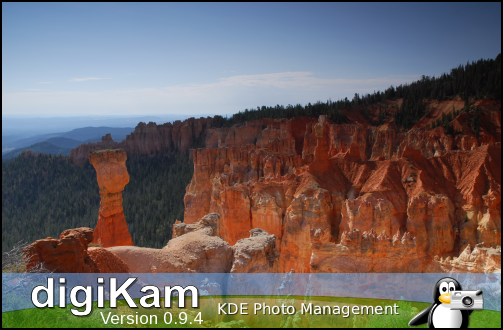
Gilles Caulier: digiKam 0.9.4 splashscreens contest : and the winners are...This week end, the team have voted to choose the splashscreens used with next release. You can seen the pictures below:
digiKam 0.9.4: Michel Pottier Showfoto 0.8.0: Frédéric Martinot Categories: KDE blogs
Thiago Macieira (thiago): Many new Qt releasesThe former Release Manager here at Trolltech told me that the former former Release Manager had a saying: The release is not out until you blog about it So I’m doing a 3-in-1 blog! Qt 4.3A week and a half ago, we released Qt 4.3.4, containing some bug fixes to issues reported to us since 4.3.3 was released. It seems old news now (even though it’s only my last blog entry), but Qt 4.3.4 is also the first Qt 4 release under the GPL version 3. The snapshots were already under that license, but now system integrators and Linux distributions can upgrade their packages to an officially released version. Qt 4.4Then, one week ago, we released the long-awaited first beta for Qt 4.4, containing a lot of new features, like WebKit, Phonon & backends, network access, Qt Concurrent, Widgets on the Canvas, improved printing support, Patternist, Aliens, a new help system and a lot more that Trolltech developers have been blogging about. This release is so big that we could have split it in two or three and we’d still have enough to go around — note how there are 17 links to blogs about different features in the previous sentence alone! (We’re still writing the change log file for the release) It’s also very daring: who could have imagined a full web engine built in the toolkit a year ago? And just like Qt 4.3.4, the 4.4.0 beta 1 Open Source edition is licensed under the GPL versions 2 and 3. The beta 1 also marks the first new platform for Qt in many years: Qt/Embedded for Windows CE. It’s now the fifth platform that Qt supports, after X11, Windows, Mac and Embedded Linux (QWS). It’s the result of a year and a half of work done mostly by the Trolltech Berlin office, trying to adapt our existing Windows code to a deceptively similar platform. If you have tried to develop for WinCE, you’ll have noticed that the APIs that are available in the Microsoft products are full of subtle differences and not-so-subtle omissions. Well, Qt brings you a unified, cross-platform API, across the board. Qt 4.5… (not quite)Talking about new platforms and deceptively similar platforms brings me to the Mac. Apple has not been afraid of changing their platform under you. The 10.5 (Leopard) release of MacOS X is full of those changes, including some that may break existing Qt applications. Qt 4.3.3 introduced initial support for Leopard and that was improved with 4.3.4, with a fix for OpenGL because Apple changed the typedef of a type. And today we announced the first alpha of the Qt/Mac Cocoa port (hmm… can I call it the sixth platform?). It comes to emphasise our commitment to the desktop PCs, to our customers and providing them with an upgrade path to newer systems. (For those of you not following the Mac news, Apple decided to halt development of the 64-bit version of the base libraries that Qt depends on, called Carbon; so we had to rewrite a good portion of our code using the Cocoa libraries) As any other alpha, this release is expected to be full of bugs and missing functionality. Trenton has posted a list of what’s known to work and what isn’t in his blog. As soon as possible, we’ll make snapshots of the Mac Cocoa tree public so users can follow what’s going on. More news on snapshots at a later date. ConclusionSo, that’s it: in the space of a week and a half, we have released three Qt versions, in three different minor series: 4.3, 4.4 and 4.5. And that’s not it: we’re scheduling a 4.3.5 and possibly a 4.3.6 release some time in the future, for those clients who cannot or will not upgrade to 4.4.0 when it’s out. And since no more betas for 4.4 are planned, the next release will be the first Release Candidate sometime in the next 3-5 weeks. (In fact, I wrote a rough initial timeline for a year and a half worth of releases. And no, I cannot share that document, since it’s pure speculation at this point) I’d like to thank everyone involved in making those releases possible: the development team (the Windows CE and Mac Cocoa teams in particular), the support engineers, the Product Management team and all of our users and clients. Yeah, without the input and feedback from you, we wouldn’t have come up with the releases. I couldn’t finish this blog without mentioning Nokia: while the planning of the integration is proceeding in several fronts, we continue to work. And quite hard. I hope three releases in a week in a half shows how committed we are to what we do. And we will continue to do what we do best: provide you with the best toolkit you can find. For all platforms: “Code once, deploy everywhere” (I think I have to pitch this slogan to Marketing…) Categories: KDE blogs
Celeste Paul (seele): NIN CCs “Ghosts”He did it (even after his slight disappointment with Saul Williams’ release statistics). Trent has released a 36-track instrumental album, Ghosts, under a Creative Commons license (CC by-nc-sa). MP3s are available through torrents and FLAC files (and other formats) are available for only $5 and various collector editions of hard media and artwork for a bit more. Support free culture and the artists who produce it. I did. (Although I suggest downloading the MP3s now via bittorrent and waiting a few days to purchase the FLAC files, their servers are in pain). Categories: KDE blogs
Jonathan Riddell (riddell): Taking a Look at the Akademy 2008 SiteAkademy 2007 organiser Kenny went to Belgium a few days before FOSDEM to scout out the Akademy 2008 location. Categories: KDE blogs
Chani Armitage (Chani): summer is comingit’s that time of year again, when young developers’ minds turn towards… well… more coding. :) Summer of Code is revving up for another year. ideas are coming together. sure, it’s not summer yet (it’s bloody cold in shanghai, actually, and I’m hivering as I write this) but preparations are made earlier every year, and anyone who’s serious about SoC knows that the early bird gets the t-shirt. ;) to the students at the beijing conference who weren’t sure how to get involved (if any of you are reading this): now’s your chance. SoC is all about helping students break into the free software community. really, all comp sci students should be applying for SoC :) it’s frigging awesome. you get to spend the whole summer hacking, on your own schedule, get paid for it, *and* you get shiny google gear. oh yeah, and something cool to put on your resume. and you get to make friends in whichever corner of the community you contribute to, become a part of that community, and next year have other new developers looking up to you and asking you questions :) remember, community and communication are incredibly important things. good communication before your application gives you a much better chance of being accepted, because developers who don’t communicate aren’t very useful - especially in larger projects. we’re all in this together; developers help each other out, discuss ideas together, and try to avoid stepping on each others’ toes. a happy, friendly community makes working on the code much more enjoyable. :) as for myself… I’ve been too busy to think much about SoC yet. haven’t put up any of my ideas for plasma or anything. I’m not even sure whether I should participate as a student, or as a mentor, or just skip this year. I’d like to do another project, and the money would be useful, but I’m not sure if any of my ideas are really project-size, and I have so many, many ideas that I’m not sure I’d like sticking to just one. I also kinda feel like I’d be taking a spot away from potential new students who need the mentoring more than me. it kinda seems like plasma could use another mentor, but I’m not sure I’d be any good at that, and it’d take away from *my* hacking time. ah well. I still have a couple of weeks to decide. Categories: KDE blogs
Sebastian Trueg: Generic and nice-looking ratings all over KDE (wouldn't that be nice)I just commited the finalized KRatingPainter to svn trunk which allows to paint a rating value using any QPainter. I think it is quite nice since it allows to specify the alignment, a spacing, a custom icon, the maximum rating, a hover rating, and so forth. And I think it would be great if this class (and its easy-usage widget companion KRatingWidget) would be used throughout KDE whenever we want to display a rating value. Although it is part of the Nepomuk lib at the moment, it has no real dependancy here: the rating is a simple integer value. A little test application shows the rating widget in action: Categories: KDE blogs
Roland Wolters (liquidat): An incomplete list of high quality Open Source games
First of all the games where I also found a promo video: The same is true for the first person shooter Tremulous: In case you loved the UFO-XCOM series, you will find yourself at home at UFO: Alien Invasion: Glest, a real time strategy game with wizards, trolls and the like: In case you love classical Jump’n'Run games, Secret Maryo Chronicles is the way to go: Next a set of games which might be a bit calmer (and don’t have a promo video), but are nevertheless exciting:
All of these entries above have three things in common: they are all actively developed by a healthy community, they are all very appealing and have high quality graphics, and they are all comparable to the proprietary competitors of the corresponding game type. Some of them are better, some of them are as good as, some of them fall a bit behind - but not much. And they definitely meet the requirements of the occasional player and are a way to spend hours and hours. Of course I’m well aware that there are many more Free Software games - but I’ve kept my focus on the games which at least released one full working (feature complete, playable) version and are in active development. And of course I only listed games I know of. Although I think I covered all the shooting stars of the Free Software games genre I am open to any other suggestion! But while these games are great, the Open Source community sometimes fails to advertise them. For example, many of these games are included in the distributions - but did you ever see a Linux distribution review featuring the included games? It should be included in the release notes and reviews that a Linux distribution most often is not only a nice set of Office software but also comes along with a rich set of high quality games. Fedora for example has a dedicated project for games, the Fedora Special Interest Group Games which helped to bring many games to Fedora. Except Secret Maryo Chronicles all games above are available on Fedora and just a click away. It takes more than 1 GB to install all these games - but that is definitely worth the space. And if you like them: promote them! There is btw. only one genre which I personally miss badly: MMORPG. Of course there are projects dealing with it, but none of them has released a full, stable version yet. But that might be not too bad for my person because I still have to finish and hand in my final thesis these days, and a free MMORPG would give me quite some time problems. Categories: KDE blogs
|
|
|