SearchAre you ready?
Account toolsUser loginWho's onlineThere are currently 0 users and 12 guests online.
|
Marcus Hanwell (cryos): Avogadro 0.6.1 ReleasedI am pleased to announce that I tagged and released Avogadro 0.6.1 yesterday evening. This is a bug fix release which fixes one pretty large bug that slipped through - the OpenGL context was lost if switching between virtual desktops, multiple views etc rendering the OpenGL window useless unless the application was restarted. As such I would encourage anyone running Avogadro 0.6.0 to upgrade to this new version. It also features several smaller bug fixes and feature enhancements. The screen shot above shows Avogadro 0.6.1 running in a KDE 4 session. One of the small visual tweaks I made was to add a second light source to our default OpenGL scene which really helps to illuminate the other side of the scene. Thanks go out to Albert for his suggestion of adding another light source. Hopefully there are no really big bugs remaining but Avogadro is still in the beta stages of its development. It is rapidly approaching a stable release though and I am very happy with our progress so far. We would love to hear what you think of Avogadro. I had one person question why we always have to use the latest and greatest version of OpenBabel and felt I should offer some explanation. Many of the features exposed in Avogadro use functions and structures in OpenBabel. I myself was quite heavily involved in improving OpenBabel's support for Gaussian cube files and the cube format so that we could load and display orbitals for example. As such we often add new features or fix bugs in OpenBabel trunk and so a new release of OpenBabel must be used in order for everything to work. There are already ebuilds for this latest version in the Gentoo tree. Ubuntu/Debian builds are in the process of being built. We should hopefully have Mac and Windows binaries very soon too. I am headed to a meeting in the UK where Donald and I will be talking with other scientists about visualisation in chemistry and related areas. We will of course be showing off Avogadro as well as talking with many other people working in this area. I am very much looking forward to it and hope that this will lead to further innovation in the Avogadro project as well as the open source chemistry movement in general. It will of course be great to have a full English breakfast and some real ale too! Categories: KDE blogs
Roland Wolters (liquidat): fsdaily.com - a digg-like portal for Free and Open Source Software
The more important question however is if it will suffer the same problems as digg.com. While I loved digg.com when I first discovered it I dropped it some months later due to quite some disappointments: digg is, after all, just a place for the masses. So the relevance is also defined by the masses. And well, the masses love sport, glittering things and naked skin. The equivalent in the software world might be iPods, themes and desktop screenshots. That’s ok for the masses, but as a result digg.com is just not the place if you want to get decent information or want to follow technological development. That however might be the case with fsdaily.com - although I must admit that even the FLOSS world might have it’s equivalent for sport, glittering and naked skin in the form of a dozen hot flame wars. But at the moment the situation looks rather calm, and due to the specialized focus I think the topics will stay more technique related and really interesting than just glittering. Also since it is still a quite small project, you can still influence it quite a lot with just a couple of people. So where is the next Commit Digest? In the end it’s the community which decides which news are interesting. Categories: KDE blogs
Josef Spillner: Multiplayer scenarioSomewhen after midnight last night GGZ 0.99.2 snapshot was uploaded. Just a few hours after, the next cool patch was created. Development runs at high speed at the moment, even though I’m still busy drawing presentation slides like a dull ODP monkey for my 2nd job (lecturer). After my two FOSDEM presentations and some chatting after each I think that while the software required to achieve high-quality free multiplayer gaming isn’t there yet, the individual puzzle pieces already let us forebode a scenario of some sort, as a guide of what shall (or will) be possible. We have GSoC 2008 proposals coming up for those who want to help out. The scenario goes like this: Bob wants to play Chess with Eve. (He used to play with Alice but they broke up, just to introduce some dramatic content here.) He might be logged into his GGZ core client already, possibly lurking at the Chess or Freeciv room, or he might hang around on Jabber. As soon as he finds Eve, he’ll launch a game of Chess and selects his favourite client, e.g. GGZBoard. Eve then joins this game using Tagua since she’s on KDE 4. Hurray for protocol compatibility! Alice joins as a spectator and is totally jealous of the two players. She decides to found a player club called Toxic Pawns and invites tons of people. She’s a good club leader and also a helpful, above-average player and thus gets granted host status, which gives her privileges such as kicking players and sending private table messages, and of course hosting tournaments. In order to accomodate those players who came up with a new set of rules called Rookymotion Chess, who are believed to prefer playing audio files over playing games but like Chess nevertheless, she requests a new room from the community administrator who easily sets one up based on existing room templates through the community web frontend. Meanwhile, Bob and Eve continue playing individual games, although Eve’s DSL connection often breaks for no reason. Of course, she can regain her abandoned game seat after a reconnection. One day, the server goes down, yet after a reboot all games are being restored. No data is lost, and no data is being leaked due to encrypted connections. The player’s personal page also features a privacy section which Eve prefers a lot to the ad-driven, privacy-invading other social networking sites she knows. Trust is important in online gaming, since technical efforts to prevent cheating can and will always be defeated at some point. But with karma points, veteran status and other community relationship indicators, Eve can rest assured that Bob’s friends are trustworthy people. So much for the community-oriented view on all the technology which is currently on the work bench. Except for a few shameless plugs, the presentation should have shown that the software is making great progress and it’s about time to think about community and player-oriented concepts. Gaming is still one of the areas where free software isn’t #1, and changing that requires some vision beside the daily coding. Send comments to any game list I’m subscribed to. Categories: KDE blogs
Stephan Binner (Beineri): CeBIT 2008 ImpressionsYesterday I made an excursion to CeBIT. Despite some major names missing and three halls staying closed it's the world's largest IT fair - and my legs remind me today of my marathon. Many halls were rather boring, the ones where the World Cyber Games took place were in opposite rather crowded. Dunno why watching others playing computer games is popular. Or the spectators were all their girl-friends who had free entrance on World Women Day. AMD wins the biggest bag contest. And many exhibitors seem to want to win in the 'Germany's Next Top-Hostess' contest. openSUSE and KDE were present at the Novell booth and in the rather disappointing sized Linux Park: Martin blocked the hall corridor with his openSUSE talks at the Novell theater. The last picture shows Michl giving a talk (in German) about the openSUSE project in the Linux Park forum. It will be repeated today at 15:15 CET and streamed by Linux-Magazin (records will be available later). Categories: KDE blogs
Paul Adams: Oh, the irony!I am a big fan of the International Conference on Open Source. Once upon a time I was on the Programme Committee; that was back in 2005. I like this conference for a few reasons:
So it was with great joy that I find that I have had a paper accepted to this year's gathering. It was coauthored by [ade] and Andrea Capiluppi of the Centre for Research on Open Source Software at the University of Lincoln. So why is it that final submissions have to be made in Word format? My preference is for LaTeX, but surely even ODF would make an infinitely saner choice? Of course it would. Springer is the final publisher. Hopefully they will see the light before next year's conference. Categories: KDE blogs
Boudewijn Rempt (boud): And even todayAn angry historian have published an "opinion piece" in my newspaper telling the world that heroes should be forgotten. English Auschwitz survivor dies The idea being, it's not the heroes, but the ordinary people who make history. Yeah, well... but who will inspire the ordinary people to do the right thing when they make history, if we don't have genuine heroes? Categories: KDE blogs
Boudewijn Rempt (boud): A Short History of A Young KingdomBehind the fold, because this is roleplaying stuff, background assembled for the fantasy roleplaying game campaign Irina and Eduard are playing in. I'll need to expand it: we've been playing this campaign for about a decade now. Categories: KDE blogs
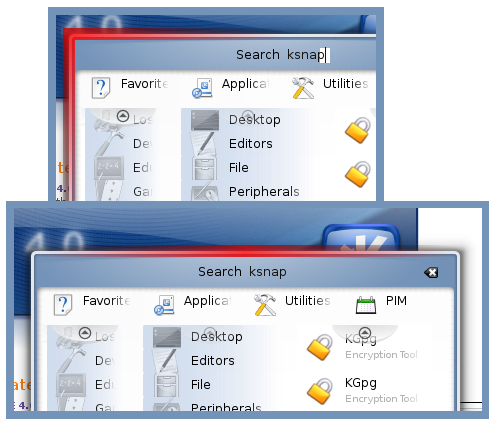
Ivan Cukic: Lancelot and resize feedbackFirst of all, Lancelot can be resized from now on. Just like any other window - drag any edge or corner, and you’ll change it’s size. But that is not the main reason behind my blogging about this. Since Lancelot /is/ a ground for experiments, here’s another one. Instead of just changing the mouse cursor when you reach one of the edges to one of the resize cursors, you get a more notifiable feedback - the color of the border changes as well. Since a screenshot is worth hundred lines of code… here it is: The highlight will be themable. Categories: KDE blogs
Kevin Ottens (ervin): On Student Projects and Hacking Sessions in ToulouseOnce again I didn’t blog in a while… In particular I didn’t blog about this year project students even if they got covered once in the commit digest. Now we’re two weeks away from the official end of those projects, so I thought it might be a good idea to show some of their accomplishment. Kapman This year we experimented with a project starting from scratch, and apparently we had some demand for a copy of an old famous game… hence why now we have Kapman! It’s kicking and alive, it’s in a pretty good shape already so maybe it’ll be able to enter kdegames in 4.1. Of course it’s all SVG based so you can freely resize it (artists wanted!). Kscd We also poked the good old Kscd… Our team made quite a lot of improvements in there. In particular it’s now fully themable using SVG (artists wanted!), and uses MusicBrainz to identify discs. Of course it also got the expected KDE4 refactoring: it got ported to Phonon and Solid. Ksirk Ksirk is one of those games we have in playground for quite some time. One of our team has been working on it to improve its quality and make it releasable… It’s definitely getting there. They mainly worked on improving its usability and that shows in my opinion. At least now I feel like I could play with it for hours. Kopete Last but not least, this year we got a team working on Kopete. They did an awesome job, it’s harder to demo or to make a screenshot for it, but they mainly focused on integrating support for UPnP and for the new live messenger protocol. On the UI front it looks less impressive, but I’m very proud of this team, they definitely had the hardest project to work on and learned a lot. Since I had no screenshot to offer, here is a picture of today’s “Kopete Gang of Four” who attended the hacking session:
A few words on the hacking sessions… Of course, after last year projects we kept the good habit of having KDE Hacking Sessions in Toulouse, we even have now a few people who are coming regularly… the community is definitely growing here. And during the student projects we have an unusual amount of my students showing up.
Missing on the picture: Thibault Normand who arrived later, and Alexis Menard who is unfortunately sick today. Categories: KDE blogs
George Goldberg: Decibel gets a TextChannel GUISo, decibel finally has a demo that lets you have a “normal” text chat. All you need to do is checkout the latest version of decibel from kdereview SVN, build it, and you should have demos/textchannelgui built. So, launch decibel and start a chat with your decibel account. It should pop up with hideously ugly, but functional GUI, and you can even send messages back! Please note that both the appearance and the code are hideously ugly! I’m going to make it less unpleasant soon (unless somebody beats me to it Code can be found here. No screenshot yet because its just too painful on the eyes. I’ll post again soon when its looking better, and I promise there will be screenshots then. Categories: KDE blogs
Boudewijn Rempt (boud): Cross-platform to the rescueThere have been discussions all over the place about whether it would be a good or bad for the uptake of free software to make applications available for non-free platforms. Having complained in the past about the way my daughters' are forced to use Windows software for school, notably Microsoft Office. So, when Naomi told me today she had to download an application to do some music homework I was filled with apprehension. Turns out the chosen application was Audacity! Plus some instructions to download a precompiled lame ddl... Well, one apt-get install audacity later she's in business. Now if only there was a distribution that supports both sound and a usb wifi stick for her laptop, she wouldn't have needed to borrow her sister's laptop. Lesson learned: cross-platform applications make the update of a free platform possible, even if the powers-that-be still live in benighted obscurity. Categories: KDE blogs
Tom Albers: Random week of a Mailody developerIn case you wonder what I've done this week, I will show you some screenshots of the progress of Mailody this week. One important thing preventing me to switch Mailody4 was the fact that I could not use attachments yet. In KDE3 times we used KFileIconView to display the attached attachments in the composer. After a rename to K3FileIconView, in the end it needed to be removed from the KDE repository, so I had to comment out the functionality in Mailody. To refresh your mind, this is how it looked in Mailody3: I requested on IRC what I could use to let it look the same and some advised me to use a QListView with a Flow LeftToRight. I tried that, and after an evening fiddling with settings and adding the needed context menu (open / delete) and hooking it into the composer, it resulted in: It's almost the same, so the average user will not see the difference, but still it was a couple of hours work. But as it is a proper Model/View, there is now the option to make it all different without much work in the future. I like the column based layout from the old one more then the fuzzy positioning of the new one, but for now this will do. At this stage I'm not prepared to spent hours on it, if I'm even capable of doing that ;-) The next point was that the pulldown menu's for the identity and mailtransport selection was taking up too much screen estate in the composer. So I made those comboboxes optional. But then you don't have any indication about which identity is being used and you can not change it easily. And then I saw an empty StatusBar ;-). So I added it to the statusbar and made it clickable to be able to switch to another identity or mailtransport. And best of all, it's close to the 'send' button of the composer, so it's natural as well. Here is how it looks: I know clicking on statusbar items is not really intuitive, but we also have it when viewing messages in the mainwindow, so Mailody users might be familiar. Also that doesn't hide functionality, as the combo boxes are still available. I also know it does not look as slick as the usual Plasma widget, but then again I'm not born for that, so if anyone wants to pimp Mailody, I'm happy to talk to you. Final remark is that the statusbar does not look like a statusbar anymore, no line above it, slightly smaller font, etc. I'll just blame the used style. ;-) The last feature I implemented this week was a long standing feature request from myself and a co-worker. Simply save all incoming attachments in a certain folder. It's a great feature (first implemented by Eudora afaik), because you don't have to save the attachments from a mail to a certain folder when you need it, it is simply there in a folder (which you can open with your favorite shortcut). Also you might remember after a few months something about a pdf you have received a couple months back. It's simply still there in that folder, while you might not find that e-mail back. I know that folder can grow rapidly in size, but harddisks are cheap and it is deactivated by default.
The checkbox is really a QGroupBox which is checkable. Anyhow, that was what I did this week. I'm almost ready to start Mailody4 now, it is going to be the best Mailody release ever for me. Categories: KDE blogs
Tobias Hunger: Say “Hi” to Telepathy-QtSince the Decibel realtime communication framework is currently reviewed for inclusion into kdenetwork I had a short discussion with some of the Tapioca Developers. As you might be aware (but probably are not) Decibel uses Tapioca to make working with the Telepathy spec more comfortable. We thought that it would be nice to have the libraries necessary to build Decibel readily available in KDE’s own subversion repository. The realease team did not mind, so I went ahead and imported a shiny new version of Telepathy-Qt into trunk/kdesupport/telepathy-qt. Telepathy-Qt offers Qt-based language bindings to the Telepathy specification. This version is almost completely generated directly from the XML files forming the telepathy specification and thus much easier to update than the version Decibel is currently using. Unfortunately a lot of names changed with this update, so it is no drop in replacement for the version currently used by Decibel (which is really starting to show its age by now). Birunko and others are already working on brushing up Tapioca-Qt to work with this new version and want to drop their results into trunk/kdesupport/tapioca-qt as soon as it becomes available. Once that code is there we will still need to brush up Decibel a bit so that it can take full advantage of all the new features and interfaces available in the newest version of the Telepathy spec (and to fix the fallout caused by the renames in Telepathy-Qt). Categories: KDE blogs
Boudewijn Rempt (boud): On being part of a publicity machineI doubt anyone but myself has noticed, but I've been blogging less and less lately. Partly because I've been really busy, but also because everytime I was writing an entry for Fading Memories I was thinking of whether it would help or detract from the KDE publicity machine that Planet KDE has become. I have always maintained that since I never asked for syndication on any planet, I didn't care whether what I wrote fit in or not. If I blog about Easter, and it gets syndicated and the Gnome games maintainer complains in the comments section about me bringing religion in the public realm, I couldn't care less. After all, he has blogged about his religion and got his blog syndicated on Planet Gnome, too. But on the topic of KDE, KOffice I feel the curious urge to constrain myself end exercise restraint unless I've got another gosh-wow-bang-zip innovation to report. And that may well be counter-productive: when I started working on Krita in 2003 nothing worked and the project was nearly dead. A powerful stimulant. Bart Coppens recently said on IRC how the fact that even the line tool was broken gave him the courage to try and hack on Krita. Adrian Page got sucked into hacking on Krita because I was too dim-witted to make free-hand painting work. Admitting that there are problems, that things are broken and need fixing can be a powerful inducement for people to start helping out. When Bart Coppens told the audience at Fosdem that it seems likely that only a tiny fraction of the KOffice applications might make it for 2.0 release of KOffice, we noticed quite a few people dropping by on irc and asking us what they could do to help. So: people, there is plenty left to fix in KOffice. There are plenty of interesting but not too hard things that you can pick up. There are quite a few quite patient people around on the mailing lists and on irc who are prepared to spend an evening helping you get started. And -- we're still committed to making something that's fun to work on, fun to with and that will really boost your capabilities as a coder. Categories: KDE blogs
Richard Dale: Adobe Flash on Linux is crap, will it damage the brand?I recently upgraded from Kubuntu Feisty to Gutsy, and all went well apart from one thing. Konqueror began putting up a crash dialog everytime it accessed a site with Flash, making it pretty much unusable. In fact until I had this problem I didn't realise quite how many pages on the web use Flash. So I searched for more info about the problem and found Lubos Lunak's blog Why Flash sucks, which described what went wrong. He says "The latest Flash update does not work with anything that is not Gecko-based." Well that's that then; they really don't seem to care about Konqueror support. Then I went and had a look at the blog about Linux Flash on the Adobe site. It actually reads more like a series of press releases than a blog, because the author doesn't appear interact with the readers of the blog and their comments See the comments on the blog about the latest release of Flash for Linux, there are 107 comments and about 95% of them are pretty hostile and pissed off. It reminded me of all the comments on the Internet Explorer 8 blog - some poor developer was having to put up with piles of totally exasperated developers who were sick of wasting their time dealing with problems in the utterly inadequate IE6/IE7 browsers. Flash is being developed very slowly, it has major bugs (greatly increased CPU usage and crashes for instance), it doesn't run on all platforms. A bit like IE really. I read about a work round where you could install an older version of the Flash plugin for Konqueror to use, while Firefox picked up the newer buggy one. That didn't seem a good idea, and would only prolong the agony. So I found out about the gnash plugin for Konqueror, did an apt-get install, and bingo! no crashes anymore. Fixfox still works with the Adobe version of Flash and I can use that for when Konqueror doesn't work. Until this experience I had a very high regard for Adobe, technologies like PDF and Postscript are excellent and also well documented to allow for alternative implementations. In contrast Flash doesn't work well, and doesn't have an open specification, and not only that, but they are about the add DRM, digital restrictions management to it. I have no problem with Adobe selling proprietary technology as long as they don't attempt to privatise public infrastructure like the web. I think it is very important to avoid AIR as it is based on the same dodgy proprietary foundations as Flash. Something like Qt with Javascript bindings (or QtRuby even) combined with WebKit can probably do everything you can do in AIR in the way of writing stand alone 'webby' apps. And Plasma also allows you to integrate the desktop better via widgets, which Air doesn't do. When Sony added a root kit to some of their CDs and then didn't apologise afterwards, that pretty much 100% destroyed the brand as far as I was concerned - they totally lost my trust. I don't think the Adobe Flash is as bad, but it probably has knocked 20-30% off the brand value from my point of view, and reinforced my idea that no public infrastructure should depend on non-Free software as it just isn't suitable for that Categories: KDE blogs
Troy Unrau: Secrecy lifted...So folks, now that the polls are closed, I can finally lift the veil of secrecy that has been sitting over my life for the last three weeks. For the last few weeks I have been waging a somewhat major campaign for the Presidency of the U of Manitoba student union. Due to archaic election by-laws, the internet was off-limits for all purposes but email for the last little while. Yuck. Anyway, you can read some details (if interested) at the website of our campus rag at themanitoban.com
Anyway, this was not a small campaign, as our student union represents about 23,000 undergraduate students. Right now the ballots are being counted, but I will be happy no matter the result. If I win, then I have work to do, and will have a very busy year that is likely filled with more politics than scholarship. However, if I lose, then I still have a summer job contract sitting there for me which will keep me busy for the summer. I am very happy about my decision to run this campaign, even though it was a great deal of effort, as I got my platform out in the public and received a warm response from 90% of the people I talked to. Since the closing of elections, I have received a number of emails from individuals who are patiently awaiting the results, and although it won't be made public until Sunday, I am celebrating already... ...By drinking the bottle or wine that I got as part of my organizational efforts in Mountainview. I shared it with Sonya (my cuter half) tonight, and I must say, the wine is just as good now as it was in California. Thanks again Celeste for the wine -- it's amazing :) The wine serves two purposes: if I win, it's the celebratory wine, and if I lose, it's a celebration of the end of campaigning, where I very successfully sold what could have been an unpopular platform only a few years ago. You see, in Canada, education is a provincial jurisdiction, and in my province (Manitoba), tuition has been frozen at all major public universities for eight years now. (There are no major private universities here.) My platform included elements that would have seen tuition rising alongside inflation in order to ensure the competitive nature of the university, both nationally and internationally. We'll see if the students bit or not. Cheers folks -- I'm sure my next blog entry will contain the results :) Categories: KDE blogs
Gilles Caulier: digiKam now support full color themable interface...If you have already tried pro-software to manage photo as Lightroom(tm), Aperture(tm), or Lightzone(tm), you have certainly seen than the interface support color theme, generally using dark color...
This is now the case for digiKam! Following intructions from Daniel Bauer from this Bugzilla entry, i have patched KDE3 and KDE4 implementations in this way. Categories: KDE blogs
Nikolaj Hald Nielsen: Nearing first alpha, and lots of cool new stuffIts been little while since I wrote a nice long update about the state of Amarok 2, and we have been getting a few complaints that there is not enough ews being posted, so I will try to remedy that here. And I have a nice pile of screenshots ready for you!
First up though, we have decided to put a feature freeze in effect starting at the end of this month. This is the first small step towards an eventual release of Amarok 2.0, and hopefully it will help us get it ready sooner rather than later. This also means that we are at the point where bug reports actually start to become useful. More on this in the coming weeks I am sure! So, whats new in the land of Amarok 2. Lots actually. First of all, I have tried my hand at some small but quite visible modifications to our svg theme, and I personally thinks the results are very prommising. I just need to figure out what do do about the volume slider... And of course, the theme still adjusts itself to the system color theme: At Magnatune.com, we have been adding free ogg streams along side the existing mp3 streams. Of course Amarok should also benefit from this, so I finally got around to implementing a stream selection GUI. This also allows people with slow or unstable internet connections to select the lofi mp3 streams: I think I can reveal, that as an added bonus, people who decide to purchase one of Magnatune.com's upcoming memberships will be able to enjoy ogg streams in a really nice quality A lot of work has gone into the last.fm service and integration. The bulk of the Amarok 2 last.fm service was originally done by Shane King, but this week there has almost been a competition about who could do the most cool things with the last.fm service. This however also led to a slight case of "interface wars" as we currently cannot decide between buttons and tree views for the different streams, but I am sure we will figure something out eventually Right now the last.fm service looks ( I am warning you, it is not pretty... ) like this: A really nice feature that was implemented by Dan Meltzer ( aka. Hydrogen ) is the ability to right click any artist in your local collection and add a last.fm stream of simmilar artists directly to the playlist: I have spent some time adding capabilities that will allow any track or stream with special actions that only makes sense when that track or stream is playing to make these actions available throughout the interface. Most notably, when listening to a last.fm stream it adds the "love", "skip" and "ban" actions to a small sub toolbar next to the play controls: This small toolbar and the background is completely invisible when playing tracks that do not have any special "now playing" actions. The same actions are also added to the tray menu ( and when right clicking the currently playing track in the playlist ): Last.fm is becoming really well integrated, but the great thing about the way it is done is that there is almost no last.fm specific code anywhere but in the last.fm plugin, which can be completely disabled. This means that any other service can use the same interface elements to achieve simmilar results. Last.fm is simply the first one to use these capabilities. It also means that Amarok 2 is in no way dependent on last.fm being available. I think that this independence is very important. It allows us to work with many different services and companies without anyone getting control over the core of Amarok. And this is personally what I see as the main strong point of Amarok 2. We are positioning ourselves to be able to work with and integrate content and services from a multitude of sources without the fear of what happens if one of these services stops existing, turns horrendously evil, or tries to assert undue influence over the direction of Amarok. And with reports coming in from our crew at Cebit about the huge interest in Amarok, it looks to be a really interesting future. Now, if we can just get this 2.0 out the door soon.... Categories: KDE blogs
Bram Schoenmakers: Bye Notepad++, Hello KateAt work I'm bound to using Windows XP. Being fed up with Notepad++, I suddenly realized there's probably a much better alternative. Kate! My favorite editor on Linux is available for Windows for a little while. First I thought it would be quite complicated to set up an environment which allowed me to run KDE apps. But boy I was wrong. There's a very neat installer which allows you to do Next Next Next and five minutes later I was working in Kate instead of Notepad++. I really underestimated the KDE Windows Project. You guys simply did a great job with the KDE Windows Installer and all the porting efforts. Granted, it's not ready for production yet and Kate still shows some quirks (but to be honest I don't know which quirks are in Linux as well). But I was really happy to have Kate's set of features and shortcuts also in a 'hostile' environment I also tried to use the kdenetwork module, but it was less successful sofar. Kopete complained not being able to find libkopete.dll and KRDC did not have any support for VNC or RDP. But that's not really an issue for me, I can live a few months longer with Windows Messenger and mstsc. Being able to run Kate made my day already. Categories: KDE blogs
Jeremy Whiting (jpwhiting): Progress part 2I've mistakenly been waiting for Goya to move into kdereview and then kdelibs/kdeui so I could check in my ui changes to the kns download dialog (mistakenly, because I really could work on it more, rather than sit on my backside) (pokes Raphael). In the meantime I've been looking around for other small projects to fill my time. Unfortunately, Pino keeps finishing them before I even figure out what the problem is ;) (thanks Pino).
Anyway, long story short, I got back to looking at the download dialog more thismorning. I still have lots to do to get it working as well as it did in 4.0 (at least including the same information in the ui, with a bit nicer and faster interface). Also need to get some caching stuff figured out, and probably some categorization figured out also to make Kalzium's dataset not such a pain to view in the dialog. Also need to work on/test dxs client side code to make sure it works for what we'll need it for when plasma starts to use it (Get new widgets from the internet). So small progress, but a good start, I got the dialog showing downloads (which really helps when you look at Most Downloads feed). And the provider information action working. Next I'd like to get the rating showing (maybe with those nice stars nepomuk uses?) and enable/connect rating items from the dialog itself. Then proceed to enable/connect all the actions in the Install button's menu to view comments, and such from the dialog. P.S. got an update of Rubber Windows kwin plugin from level1 this morning. Works great, can't wait to hear Stephanie's reaction when she gets on the computer later and sees it. (Will check in as soon as I get word from level1 to do so) Categories: KDE blogs
|

|
|