SearchAre you ready?
Account toolsUser loginWho's onlineThere are currently 0 users and 15 guests online.
|
Tom Albers: FOSDEM RocksThis weekend was FOSDEM, we went with 4 people and a baby of 9 months, while the woman left after the Tux in Hollywood talk to the city centre to find some chocolate, we went to see various talks. I've seen a couple of interesting talks. Not only did I want to catch up on the state of some things, I also had some things I wanted to know more about which we run into at work. Some random observations: I missed the KDE for some unknown reason. Amarok2 talk was ok, although it started with sheets, which were a bit boring. It was called 'Amarok2', so I expected more of the live demo. It's always a bit difficult to determine from the title of a presentation in which direction it will go, but the playlist looks nice and smooth, compliments for that. After that we went to 'Clutter: animating the desktop' in the GNome room, it was interesting to see, but I missed the start and could not really recover from that. I don't understand where to place the thing they made in the software stack. But it's good to see they are working on nice libraries which makes the desktop appealing to the public. The presentation after that was about Elise. It's a piece of software which aims to be the equivalent of Microsofts Media Centre. It uses the Clutter stuff and the presentation was awesome. As soon as they have television integrated to their software I will switch from mythtv to that. Or at least give it a shot. To end the first day, we went to the presentation about dstat, it is a cli tool which can be used to analyse your system, you can actually determine what your system is doing, which process is at the top of the kernel's oom-first-to-be-killed list and to enable as much details as possible. That's something we can definitly use at work to analyse some servers. After that we teamed up again at the hotel, eat krokodile steak in some african like restaurant and played a game of Cluedo before we got interrupted by the baby requiring both parents to try to calm here. On Sunday we wanted to get to the Virtual Box presentation. But we were not alone in that wish. We could not join the room anymore so we decided to find something else, the result of the random pointing at the schedule was Miro. And it was good. Miro is application which is made under the Mozilla umbrella. It's aim is to make it possible to watch movies. They pointed out that it's not really The Internet Way to have all the video's and movies on centralised servers like youtube or google video. It's a valid point, but we decided the actual cause (bandwith) is not solved by this solution. Although it's absolutely cool software which I'm happy to try out soon. The Farsight presentation was given in the cross desktop room. They explained how they have designed their video conferencing software, and that makes a lot of sense to me. It will make video conferencing so much better if they succeed. Linux / Desktop still lacks a bit in those areas and this can fill that gap. Being able to add videoconfering to random applications with not more then 100 LOC as the way it should be and give a large boost. Especially when integrated in all the popular IM applications. Not sure if it will play nicely with Phonon, or why decided not to use it. Could have been a good question for a cross-desktop talk. LVM2 presentation was fun, the presention was a demonstration about what has changed lately. I always found LVM difficult to understand when you haven't worked with it for a while. Some operations are difficult for me to understand why they implemented it that way. But they've fixed some, like making a volume bigger, no longer requires to extend the filesystem as well, it's now done automatically. I think we'll make lvm standard on new servers from now on. We ended with a presentation of ZeroConf in the OpenSUSE room. What we could see was nice, the API for KDE is nice and I might have some idea's for Mailody in that area now. But first I want to try some things to see how it works in practise. They said it was already available in Kopete, but I couldn't get find it in my Kopete (KDE3). It's great technology and strange it is not more popular... I also liked meeting a bunch of new faces. Ana was of course the most important 'new face' ;-). It was great to say Hi to everyone again, although I didn't have time to discuss things or talk to people for longer. I went to see Janneke Pis, the female version of Manneken Pis in the centre of Brussels, eat something in that area and went back to The Netherlands. Awesome weekend! Categories: KDE blogs
Adriaan de Groot (adridg): Nous sommes partis de BruxellesIn the interest of supporting the multilingual community of Brussels, today's post title is brought to you in (possibly bad) French. After a night's sleep I ought to be able to distinguish between Haralds and Nikolajs. Lydia mentions the bomb which is what kept Paul, Sebas and myself from catching an early tube train (well, this was after drinking the entire on-tap menu at the Slutty Nun bar) back to the hotel. Since the universe seemed to be opposed to us going back, we went to the FOSDEM beer event instead.
The KDE stand, as has been written elsewhere, was a success. It's hard to fit so many people into such space, especially with howling Amarokkers and hacking KDE folk. I think we managed to strike a good balance between the two projects, actually, and in the end we had people hacking on both sides of the table. Being on the "hall" side meant you were interrupted every few minutes by questions. That's fine; booth duty means talking to people. I chose to sit on the hall side and do something that looked vaguely interesting to draw people in. CMake's color output helps for that. The folk on the "window" side were protected from other visitors and could afford to look surly and/or continue to work. Or hand out refreshments to the rest of the booth. I actually spent most of the weekend sitting at a piece of proprietary hardware hacking on KDE4. In that sense I'm not that different from the MacOSX folk; darn closed (hardware) platform, Free Software on it. I think having very shiny proprietary hardware helps. This particular bit of KDE branded shinyness was supplied by Sun Netherlands, who had an identical box over at their own stand. I seriously never before have seen consumer electronics that people would actually pose with. If you want one, they are not cheap (about 150 beers at Brussels prices), but drop me a note. This particular picture is of it back at my kitchen; there will probably be pictures of the stand up at some point and you can spot it there too. The kde-artists, Nuno in particular, deserve applause for cooperating on making this happen as well, slaving at my deadlines and specifications. Session migration is one of the neat features of this thin client. The trick was to fiddle about with KDE4 on one of them at one stand and then move the session to the other device at the other stand and carry on. For that we wired up our own private stand-to-stand network, as this year FOSDEM was missing the complicated and horrible tangle of wires that traditionally lives behind the stands and under the tables. Instead, there was just wireless that worked. That was really impressive, and something that we should duplicate at aKademy. I've mentioned before that the graphics support isn't all that hot, as most of the gradients and blending that Oxygen / Plasma does is not supported; I hear a firmware upgrade in the future should get that out of the way. In the meantime switching KDE4 to Plastic / Plastique improves the look a lot because there's no more dithering. Well, most of it goes away. The Plasma panel and palette continue to show artifacts, which Aaron assures me are gone in trunk. So when I get around to compiling trunk I'll be able to see it. There were a couple of things that I noticed with KDE4 branch that I thought were really weird. Missing features, and when I raised these with some other KDE developers I got the now standard "you don't really want to do that anyway," but I think they were joking. I hope so, anyway. Afterwards Sebas showed me that at least one of these is fixed in trunk, so I'm not worried in the long term. Here goes (for all of these it might be that it doesn't show up in my build for some reason, even though it is stock from KDE SVN, so feel free to point out where I should be looking or what's going wrong in branch):
It is this kind of runtime testing and checking that we can only start doing once the software compiles fairly regularly. My Solaris box is nowhere near as new as my FreeBSD workstation, so I possibly see more issues in a local login than I would on other platforms: a Matrox G450 is not exactly cutting edge, and waiting for the grey-out effect on logout is slow. However, at this point I can use KDE4 as my desktop on Solaris pretty much all the time (as long as I don't hit ^C in konsole, but that's another story); maybe I should switch back to FreeBSD and help out on that side of the fence again. Categories: KDE blogs
Ian Monroe (eean): Dragon and QuasselHaven't blogged in a bit, so I have a couple unrelated blogs. Dragon Player 2.0.1Dragon Player 2.0.1 was released last week. 2.0.0 had a little but very visible bug (pressing the mute button would cause the mute button to disable), but luckly my sense of paranoia of such things kept me from advertising 2.0.0 outside of Dragon Player's website. Credit goes to a few years of Amarok releases going just a bit wrong at the last minute (though this year has been good to us).
Anyways I think Dragon Player 2.0.1 is a solid release. It'll probably be the last release of Dragon Player done independently, as now Dragon Player is a part of KDE Multimedia. We have a bunch of ideas for Dragon Player 2.1 (released with KDE 4.1). Mostly it all comes down to polishing the interface. About the only difference between 2.0.1 and 2.0-rc1 is the new icon. Which looks utterly fantastic in my opinion. Credit goes to Eugene Trounev of the KDE games project. They have a great community spirit, it's no accident that KDE games was fully ready for KDE 4.QuasselWhile Europeans go to FOSDEM Brussels, drinking their great beer and partying with Mike, us Americanos are stuck looking at pictures and thinking how fun it could have been. Luckly this year something else came out of FOSDEM for us lonely folks: the public release of Quassel. My initial impressions wasn't good: it stalls when you join a channel or connect to a server. But it turns out that the way you use Quassel that doesn't really matter, since the "quasselcore" stays running and you basically never have to join a channel again. So for an alpha, it is very usable and I would recommend it, even if you're only interested in an IRC client and not something to test out. Yesterday morning I added mouse wheel support to Quassel's channel list; it was good to warm my Qt Model/View muscles some. I pretty much had to add it: I would try to use my mouse wheel every time I changed channels even though it never worked. Some people (apparently everyone but me) experience crashing when they do the initial network setup for Quassel Alpha1. Alpha2 should be out shortly. Categories: KDE blogs
Franz Keferboeck: CeBIT ParticipationJust a short note, as i’m kinda busy atm, but as mentioned earlier we welcome any help at KDE events, next to come being CeBIT in Hannover. There’s a WIKI page for you to make helping even easier Categories: KDE blogs
Ruurd Pels (ruurd): feed spamBah. Anybody else getting annoyed about advertisements disguised as an RSS-article? Or Register articles telling you you can download a whitepaper but you have to register... What moron thought of that?
Sometimes I think there are people that do nothing elase than come up with ways to annoy others into NOT buying a product. Sheesh... Categories: KDE blogs
Lydia Pintscher (Nightrose): what I learned at FOSDEMAfter getting back from FOSDEM and sleeping for 10 hours I am finally back in the land of the living FOSDEM was great, I had a lot of fun and was able to connect some more IRC nicks to their real life faces. So what did I learn this weekend?
Thanks to the KDE people for letting Amarok have a good share of the booth. We love you PS: Everyone who took pictures please share. Categories: KDE blogs
Agustin Benito Bethencourt: Kubuntu days...productive daysThese last four or five days it have been Kubuntu days for me. For different reasons, I've have installed or upgraded Kubuntu in four PCs and used the Kubuntu Live CD to configure a graphic card of a computer with debian sarge installed.
Installing Kubuntu from scratch is a great sensation. It's fast and easy most of the times. My parents had at home a debian, then switched to Kubuntu Breezy and, during this weekend, I've changed their old PC by a newer one with Kubuntu Gutsy on it. They are happy because it was easy to configure the HP Laserjet 1018 (with breezy it was a nightmare for me). Everything works fine with no extra configurations. My mother not just use it, also promote it, which is something I've never expected. My father is getting into it, not 100% convinced yet I also took a friend's PC and changed her old unupdated Kubuntu Dapper by a brand new Kubuntu Gutsy. After installation, everything worked fine, specially her usb-wifi stick, something she could not get working with the old distro. I upgraded my office's PC from Kubuntu Feisty to Gutsy with the distribution upgrade tool. Everything worked fine except cups. I didn't have a backup copy of the configuration archive. Does anybody knows if it does one before changing cups by the new packet? I also installed a Kubuntu in a quite old computer after adding some RAM memory (it has xubuntu). Now it has dual boot. It works quiet well although xubuntu works faster. So, what is the point? It is that, for non technical users, as I am, Kubuntu have reached a point where I'm able to do with linux everything I used to be able to do in windows, install it, make partitions, configure a network, install apps, share printers and directories, configure wifi devices, create users, etc. very easily. In fact, I can do more things now that I could in windows. We can improve a lot though, but it has been a confirmation of what I already knew (we all know). With linux I'm more productive, even in tedious actions like the ones I've done these days.Agustín Benito Bethencourt http://agustin.ejerciciosresueltos.com Categories: KDE blogs
Christian Ehrlicher: Snapshot 4.0.63 binariesThis weekend I built binaries for 4.0.63 snapshot. Kopete should now work with jabber too.
For the next snapshot we plan to integrate okular - poppler, freetype and fontconfig are already built but we need some more time to test things :) Categories: KDE blogs
Aaron Seigo (aseigo): i haven't forgotten about youwhat a jam packed few days. tons of work on kickoff, zack's been ripping it up on webkit integration in plasma, import of quasar to playground with some initial work on it towards the direction we want to move it, getting kconfig backend plugins to actually work, krunner matching improvements (some of which required a bit of hacking on the sycoca query language), the port to WoC patch is shaping up (not my work, i'm just the reviewer) and sooo much more .. including going out with zack in the evenings to dance and what not .. it is the weekend after all and p. is at his mom's.
we're going out again tonight and i'm way to mentally tired to do much other than enjoy it not thinking .. tomorrow i'll be putting out a screencast showing some of the stuff we've been poking at. but i wanted to let you know that i hadn't forgotten about you, the reader of this crazy thing i'm told is called a blog, and that i still think of you fondly at night. ;) Categories: KDE blogs
Maksim Orlovich (SadEagle): Progress...Categories: KDE blogs
Francis Giannaros: FOSDEM 2008So the greatest FOSS event of the year has come to an end. Thousands of geeks, hundreds of talks, and just a really wonderful atmosphere everywhere (see the pictures flowing in). I caught up with my backlog of emails and feeds from Friday and the weekend in only 15 minutes, which pretty much sums up what was happening in the world of FOSS at the time. Very glad to see successful KDE (with Amarok) and openSUSE booths about. We gave out over a whoopin’ 1000 openSUSE Promo DVDs (Live+Install, with KDE/GNOME/Xfce).
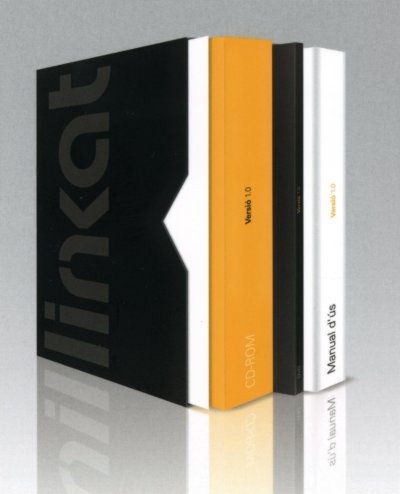
Some things in particular that I took from the event: Linkat: a distribution for the education department in CatalunyaThe Jordis presented the very professional Linkat, a SUSE-based Linux distribution now endorsed and promoted by the Catalynian government for schools and communities there, with all kinds of FOSS educational software. Interesting to hear about the many challenges faced: for example, they were asked to include the latest packages but to also provide long term support. So what did they do? They use openSUSE packages when they need to have the latest-and-greatest (which comes with 2 years of security and update support), and SLED for the base packages and everything else (7 years of support). Watch this space. The new Sat SolverProbably the talk that personally interested me the most. Michael gave a quick overview of the workings into making a package management solver. The new one is completely based on standard SAT algorithms (boolean satisfiability problem), which has nice advantages like the simple fact that there are insanely fast algorithms for computing such problems. Such small problems (in comparison) like our “very complex” package management decisions take milliseconds under this model. This, combined with the new solv files (for repo metadata), makes for extremely fast package management. Other highlights:
Huge thanks to Pascal Bleser and the rest of the FOSDEM team working tirelessly to ensure that FOSDEM ran so smoothly. Nice events like that make me very happy; looking forward to FOSDEM 2009! Categories: KDE blogs
Nikolaj Hald Nielsen: Impressions from FosdemSo, Fosdem is over, and I finally have stable network access and time to use it. My initial impression of the event would have to be that it is very crowded. Especially Saturday was quite insane with people being crammed in the halls. Shouting loud enough to explain the wonders of Amarok 2 to people cost me most of my voice.
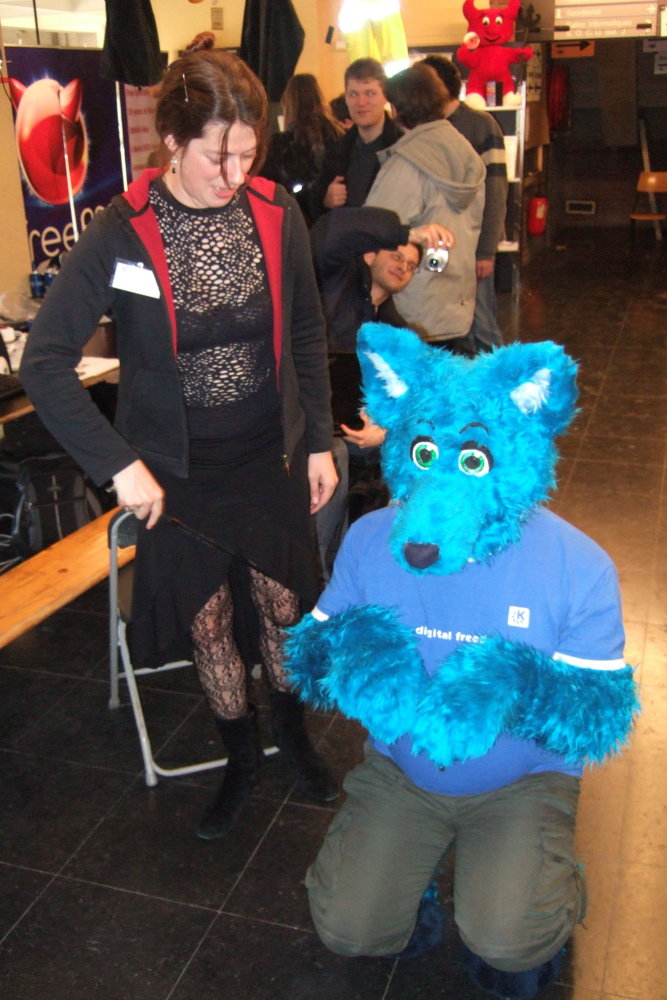
My own talk went very well, ( at least so I have been told ), but a review of all the talks in the KDE dev room should be online soon. For next year, I think we need to realise that cramming 12 Amarok people into half a KDE booth is not the optimal solution. Hopefully, in the future it will be possible to get our own area with room for showing off Amarok on more than 2 laptops I will leave you for now with my favorite among the pictures I took at the event. I actually don't think I am even going to try to explain this one. Suffice to say, that even though our new mascot Mike was quite a crowd pleaser, the BSD pople in the booth next to us had us beat hands down at the attention drawing game... Categories: KDE blogs
Pino Toscano (pinotree): FOSDEM, day 2Another day, another set of interesting talks out of the over 200 here at FOSDEM. First, I had a look at what the KDE guys at OpenSuSE are doing for KDE 4: plans to ship KDE 4.0.1 (or better, .2 as soon as it is released), whith some concerns about eg KDE PIM. Was also nice to know that they are working on porting the KDE 3 applications developed by their developers to KDE 4: KNetworkManager (using NetworkManager 0.7), Kerry (using a Xesam interface, thus more generic), KPowerSave, etc. After that, I went to the talk on KDE 4 done by Jos Poortvliet and Sebastian Kügler: lots of (interesting) bla bla ( ) about KDE 4 concepts, ideas, etc, with Jos - instead of demo'ing kdeedu, kdegames and kdegraphics - tooking more than 10 minutes just to show the universe (with KStars, of course ) to the people After lunch, other three talks followed:
Then at 5pm, almost the whole crowd of the FOSDEM started packing all their stuff, and KDE people as well. Many thanks go to the KDE people, to the Debian Qt-KDE guys (and gal, hi Ana!), and to my room mate, Marijn Kruisselbrink: all of you made me enjoy the two days at my first FOSDEM Categories: KDE blogs
Adriaan de Groot (adridg): We are out of BrusselsFOSDEM was tiring, but not exhausting, this year. I may be getting better at this game, and one unique incident occurred in that Sebas, Paul and I were at a dinner table all drinking mineral water. The friday night was epic and saturday a lot tamer. I think a lot of people felt that way. Brussels traffic continues to be my personal bugbear. But it took Sebas, Jos and myself only three hours to get home from the ULB by car (just as long as the train ride would have taken, but more convenient when hauling 40 pounds of computer equipment).
So in terms of what happened at FOSDEM Pino and Harald sum things up pretty well: there were many many interesting talks to attend. Unfortunately, I only got to attend one talk (and give one demo of SQO-OSS in the research room). The rest of the time was productively spent talking to many many different Free Software people: users, developers, translators and researchers. So I'm glad I didn't go for the talks, I would have been annoyed at my inability to attend most; but since I go for the people, explaining how KDE4 works in a cross-platform way (we had Solaris, MacOSX and Linux running side by side) is a good thing to do. Chatting about font rendering is good. Looking for locale issues when using Strigi in GNOME apps is good. Pondering developer motivation is good. There was a lot of goodness at FOSDEM. Pascal Bleser (sp?) is just awesome at organizing (for putting this whole thing together); his daughter (she looks to be about two years old) is just cute as a button. And only two-thirds terrified of all these weird people. I had to do some digging in my memory to be able to ask her about her lady-bug ring in French, but that turned out for the better because later I was answering questions about KDE EDU in French as well. Anne-Marie, we missed you. Categories: KDE blogs
Kevin Krammer: Migrating to AkonadiAs promised I am going to try to present the work I have been doing over the last couple of weeks in a less developer centric way. Bascially the idea is to have an intermediate step in moving from the traditional facilities for addressbook and calendar to the future ones based on Akonadi. Lets discuss the different approaches based on an common use case: assume you are running KMail and at some time during the day you'd like to change some contact information in your addressbook so you start KAddressBook as well, modify the contact and save the modification. The following image shows the three setups side by side:
The traditional setup is based on plugins we developers refer to as KResource framework. In the use case described above, both applications read the file and parse the contact data stored in it into objects we developer refer to as "Addressees". The "file" plugin inside KMail actually watches this file for changes, so it detects that someone has altered it and basically repeats its loading procedure, i.e. loading the file and parsing the contact data again. The migration setup is quite similar on the upper part of the diagram, i.e. KMail and KAddressBook still use plugins to access the data from a shared source. In the use case described above, only this very resource handler has access to the storage file. It loads and parses the contact data similar to how the "file" plugin of the tradition setup did, so not a big difference yet. As I wrote above the two applications basically don't care which plugin they told to use, so from their point of view there is no difference in used a plugin called "akonadi" and they have no idea that this plugin is getting the data from the Akonadi server. The main difference to the traditional setup is they way how the modification is handled. To summarise the traditional applications can, without any code modifcations, already reap some of the advantages of Akonadi, e.g. fast distribution of local changes (no access to the storage device necessary) and single points of access to storage devices. The future setup, i.e. native Akonadi support, looks almost like the migration setup when being abstracted like in the diagram. The differences are now mainly how the applications can handle the contact data internally, e.g. they are no longer limited to keeping copies of all addressee objects at all time, KAddressBook no longer needs to check which addressee objects to upload to the Akonadi server since it can now upload them individually right after modification. That's all for now. Categories: KDE blogs
Juan Carlos Torres (jucato): Randomness: School, Essays, Fun & FOSSA very busy week has passed. Didn’t give much time to sit down and look back. Luckily tomorrow’s a non-working holiday (as if I have a job), so that gives me some extra time to share some random personal junk I’ve accumulated. School! Finally, I’m going to school again! If all goes well, that is. I actually already finished my college course 4 years ago (Bachelor of Arts Classical major in Philosophy), so this is like a second degree, but not equivalent to a baccalaureate (since it actually requires that). I’m taking up Diploma in Computer Science, something I’ve wanted to take up years ago. Now I will, and fortunately for me, I would be able to take it mostly at home. It’s a distance education/home learning program, so I can stay at home, and only go to the campus for exams. I still have to apply, though. Then comes the excruciating waiting for news whether I’m accepted or not. Keeping my fingers crossed. Essays… As part of the requirements for the application to school, I’m supposed to write a 500-word essay. The topic is “what is your purpose in applying to the program and what are your plans after finishing the program?” These types of questions always smell like beauty pageant questions, and I almost can’t resist ending my answer with “and world peace.” Somehow I was hoping that the topic would be a bit more thought-provoking. But at the same time, I literally took me a week finish writing the essay, partly because of boredom, and party because of being unable to think up of ways to make my essay not look like a grade school’s answer. I somehow miss my philosophy days because of it. Fun & FOSS Two weeks ago I started reading (again, from the beginning, for the nth time), Stephen Covey’s 7 Habits of Highly Effective People. When I came across his discussion on centers, particularly the “Pleasure center”, I was reminded of how often I (and probably many other people) used “fun” as the reason for starting, staying, and even leaving their areas of FOSS contribution. I can’t remember how many times I’ve heard “I do this because it’s fun/I like doing it” or “I’m leaving/stopping because it’s no longer fun”. I’ve even said it myself. A lot. Like for example, my “zeal” in helping out in Kubuntu is slowly starting to disappear, due to some circumstances. But mostly because I don’t seem to be enjoying it anymore. This is not an attempt to strike at those people who use “fun” as their raison d’être, specially since I’m guilty of the same thing. I’ve just been reflecting on whether we should rely on something as flimsy as “fun” as the driving force for contributing. Human as we are, and as volunteers who mostly don’t get paid to work on projects, we, of course, are inclined to do what we like more. But what if, as I’ve experienced a lot, the “fun” runs out? What do we do? Somehow I feel that I myself should have some deeper, more substantial motivation. Does world konquest count? Categories: KDE blogs
Ariya Hidayat: laugh of the dayWhat will you get if you google for deutsche telekom hotline ? Categories: KDE blogs
Pino Toscano (pinotree): FOSDEM, day 1So, as I said previously, I'm at FOSDEM right now, sitting in the KDE boot, with some Amarok guys, Joos demo'ing all around, Marijn working on KDE and Adriaan hacking on the KDE4-branded SOLARIS thin client. Personal impressions on some talks of day 1:
Categories: KDE blogs
Albert Astals Cid (TSDgeos): PostScript is turing completeYes, PostScript is turing complete so next time you get a different output when printing with kpdf than the one you get when doing print preview in kpdf, specially if the print preview looks correct, blame whoever decided to use such a complex language for printers and also the drivers of your printer for not being able to understand it, do not blame kpdf.
Categories: KDE blogs
Anne-Marie Mahfouf (annma): QuickiesI was away for 1 week without internet on a family vacation in the Pyrénées. We went skiing, Léah who is nearly 10 especially misses the snow since we got back to France from Québec so she was very happy. She is very good in cross-country skiing and is full of energy! There was not much snow as the weather is too mild and ski resorts have to use snow cannons to generate snow.
Here is Little Clarisse (nearly 2 years old) and myself! Being born in Canada and being Canadian, Clarisse only got snow-aware during this week which is a bit of a paradox. Meanwhile George added a Flickr provider to the PoDT engine (Picture of the Day) so I need to fix the Frame itself to integrate this engine. Thanks George for this addition! I have various attempts of code on my laptops, none seem satisfactory enough from the GUI point of view. I started to play with QGraphicsWidget and I also started a GUI for KApptemplate in the form of a QWizard (KAppTemplate is currently a bash script that generates various KDE 4 projects that you can use to start programming). Categories: KDE blogs
|
|
|